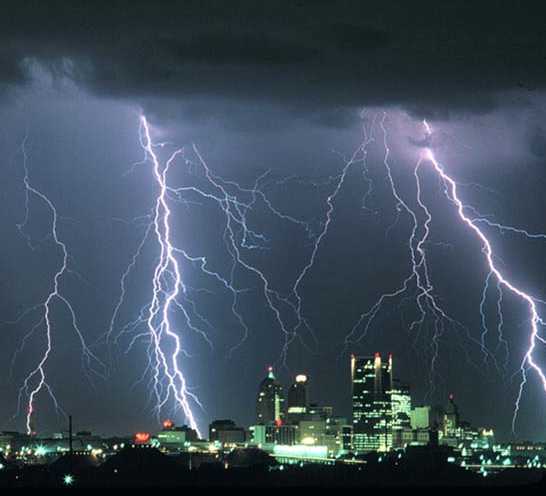
Lightning Safety
DISCLAIMER

(Picture Copyright Gene Moore)
Lightning Safety
What would a Geocaching Electrical Safety Blog be without lightning information?
We've all been out geocaching in the rain and possibly big storms. Myself included. Here are some things you should know for the next time you hear thunder or see lightning.
Contents of this article include:
-An Explanation of Lightning
-Lightning Facts
-Lightning Safety Rules
-Other Information

An Explanation of Lightning:
(The information contained here was found at (thunder.msfc.nasa.gov/primer))
Inside of clouds are small particles known as “hydrometeors”. As these particles grow and interact, the collisions cause them to become charged. After studying these particles, researchers believe that the smaller particles tend to become positively charged while the larger particles become negatively charged. Gravity pulls the larger, negatively charged particles downward, and updrafts tend to send the smaller, positively charged particles upward. The result is that the higher portion of the cloud has a net positive charge while the lower portion of the cloud has a net negative charge. The separation of particles causes a large electrical potential not only within the cloud itself, but also between the cloud and the earth. This electrical potential can become millions of volts in magnitude. Eventually, the electrical resistance in the air breaks down and lightning, the electrical discharge between the regions of the cloud or between the cloud and the ground, is formed.
A single lightning “flash” is formed by a series of lightning “strokes”. Usually there are about four strokes per flash. An average duration of time for a stroke of lightning is about 30 microseconds. The average peak power of a stroke of lightning is about 10^12 watts.
The electrical discharge, lightning, results in heating up the atmosphere immediately around the lightning strike. The lightning can actually heat the area in the general vicinity to 20,000 degrees C! (This is 3 times the temperature of the surface of the sun). The air that has been heated by the lightning is then compressed. This produces a shock wave, which quickly decays to an acoustic wave as it flows away from where the lightning struck.
The flash and the resulting acoustic wave (thunder) that was described in the last paragraph both occur at the same time, so you may be asking “why do I hear the thunder so long after I see the lightning?” The reason is because light travels at 186,000 miles per second and sound only travels at one one-millionth of this speed (approximately 331 meters per second). Thus, although the lightning and the thunder occur at the same place and time, the thunder will be heard well after the lightning is seen. The further from the lightning you are, the longer the lag time will be. In fact, one way to estimate the distance to a lightning strike is by counting how long it takes to hear the thunder after you see the lightning strike. If you take this result and divide it by 5, you will have an approximation to the distance to the strike (in miles).

Lightning Facts:
(These facts are taken from the Automated Weather Source Online)
1) Average Lightning Stroke is 6 miles long.
2) The Temperature of lightning's return stroke can reach 50,000 degrees Fahrenheit. The surface of the sun is not even that hot! (around 11,000 degrees Fahrenheit).
3) Once the leading edge of a thunderstorm approaches to within 10 miles, you are at immediate risk due to the possibility of lightning strokes coming from overhanging anvil cloud. Because of this, many lightning deaths and injuries occur with clear skies directly overhead.
4) On average, thunder can only be heard over a distance of 3-4 miles, depending on humidity, terrain and other factors.
5) Average thunderstorm is 6-10 miles wide.
6) Average thunderstorm travels at a rate of 25 mph.
This fact was taken from National Geographic Online:
7) Each flash contains about one billion joules of electricity. That's enough energy to light a 100 W light bulb for three months.

Lightning Safety Rules:
(adapted from the National Oceanic and Atmospheric Administration (NOAA))
1) Stay indoors, and don't venture outside, unless absolutely necessary.
2) Stay away from open doors and windows, fireplaces, radiators, stoves, metal pipes, sinks, and plug-in electrical appliances.
3) Don't use plug-in electrical equipment like hair driers, electric toothbrushes, or electric razors during the storm.
4) Don't use the telephone during the storm. Lightning may strike telephone lines outside.
5) Don't take laundry off the clothesline.
6) Don't work on fences, telephone or power lines, pipelines, or structural steel fabrication.
7) Don't use metal objects like fishing rods and golf clubs. Golfers wearing cleated shoes are particularly good lightning rods.
8) Don't handle flammable materials in open containers.
9) Stop tractor work, especially when the tractor is pulling metal equipment, and dismount. Tractors and other implements in metallic contact with the ground are often struck by lightning. 10) Get out of the water and off small boats.
11) Stay in your automobile if you are traveling. Automobiles offer excellent lightning protection. 12) Seek shelter in buildings. If no buildings are available, your best protection is a cave, ditch, canyon, or under head-high clumps of trees in open forest glades.
13) When there is no shelter, avoid the highest object in the area. If only isolated trees are nearby, your best protection is to crouch in the open, keeping twice as far away from isolated trees as the trees are high.
14) Avoid hilltops, open spaces, wire fences, metal clotheslines, exposed sheds, and any electrically conductive elevated objects.
15) When you feel the electrical charge -- if your hair stands on end or your skin tingles -- lightning may be about to strike you. Drop to the ground immediately.

Other Information:
In Canada, lightning kills about seven people and seriously injures 60 to 70 people a year.
In the United States, according to the U.S. National Weather Service, 73 people die from lightning strikes each year and hundreds more suffer life-debilitating injuries. Memory loss, attention deficits, sleep disorders, numbness, dizziness, and weakness are some of the maladies cited.
The highest death rates from lightning in the United States are in Florida, which is known as the lightning capital of the country. According to the service, from 1959 to 2003 lightning killed 3,696 people in the United States. Of those, 425 were in the Sunshine State. (The only state that did not record a lightning death in the period was Alaska).
Take care,
Johnnygeo
Link's of Interest Regarding Lightning:
Alberta Government Daily Lightning Map
www.srd.gov.ab.ca/wildfires/fpd/maps_fwlight.cfm
I found most of my information for this article and thank:
www.public.asu.edu/~gbadams/lightning/lightning.html#explanation
www.weatheroffice.ec.gc.ca/lightning/index_e.html
news.nationalgeographic.com/news/2003/05/0522
For picture: Copyright, Gene Moore: www.chaseday.com
(Amazing pictures on website)


0 Comments:
Post a Comment
<< Home